On the Chinese-to-English translation practice of BYD’s CSR report through Transformer & LLM
LLM translatedThis English version was produced by a large language model and may contain errors. Read the Chinese original
I. Overview of Technical Principles
This report adopts Transformer-based machine translation and LLM-driven automated terminology management as its core technical approaches.
1. The Core Logic of Neural Machine Translation (NMT) Traditional statistical machine translation (SMT) struggles to handle long-distance dependencies, whereas the NMT engine on which this project relies (such as NiuTrans) is based on the Transformer architecture. Its core self-attention mechanism (Self-Attention Mechanism) can compute in parallel the semantic association weights between each word in a sentence and every other word. When translating the long and complex sentences found in CSR reports, this mechanism can accurately capture “contextual logic,” markedly improving the fluency and logical coherence of the translation.
2. Semantic Empowerment through Large Language Models (LLMs) To address the limitation that traditional word-frequency tools (such as AntConc) cannot recognize “semantic abbreviations,” this project introduces large language models (LLMs). By drawing on the LLM’s context awareness (Context Awareness) and few-shot learning (Few-Shot Learning) capabilities, and by means of structured prompts (Prompt Engineering), it achieves intelligent extraction of bilingual glossaries from unstructured text, completing the technical leap from “text cleaning” to “knowledge graph construction.”
II. Design of the Practical Task
1. Task Background The “Supply Chain Management” chapter of BYD’s 2024 Environmental, Social and Governance (CSR) Report was selected as the source text, with a total length of 1,446 words.
This text is a typical example of “high-risk, highly regulated” corporate external communications material. It involves ISO standards, carbon-emission terminology (such as HSF and Carbon Neutrality), and complex long-sentence structures, and therefore places extremely high demands on terminological consistency.
2. Technical Application Scenario and Workflow To simulate a real localization project environment, this project designed the following closed-loop workflow:
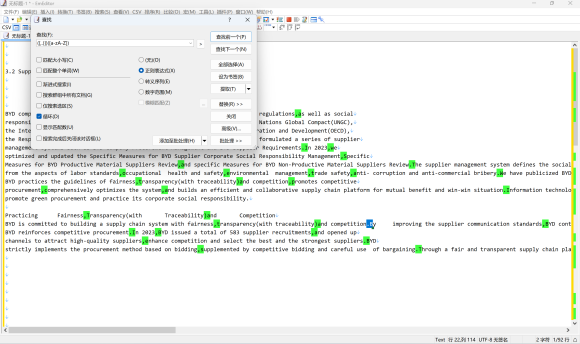
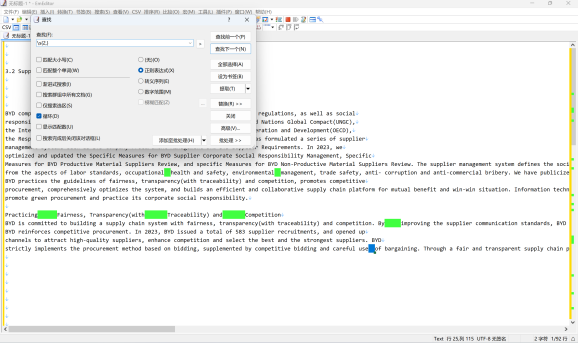
Corpus pre-processing (Pre-processing): EmEditor and its regular expression (Regex) engine were used to resolve hard-return line breaks, word run-ons and header noise arising from PDF conversion, so as to provide MT with clean input.
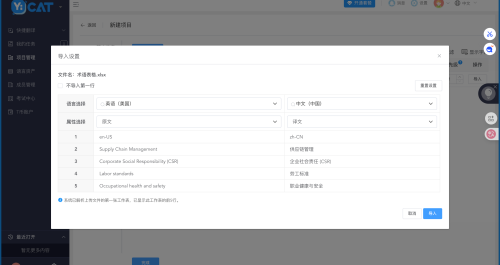
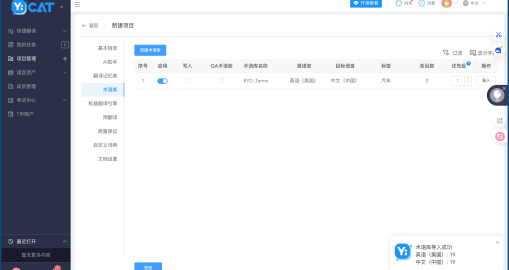
Terminology asset construction (Terminology): The DeepSeek-V3 model was used to extract core terms and build a TBX-compliant bilingual term base, which was then imported into the YiCAT platform.
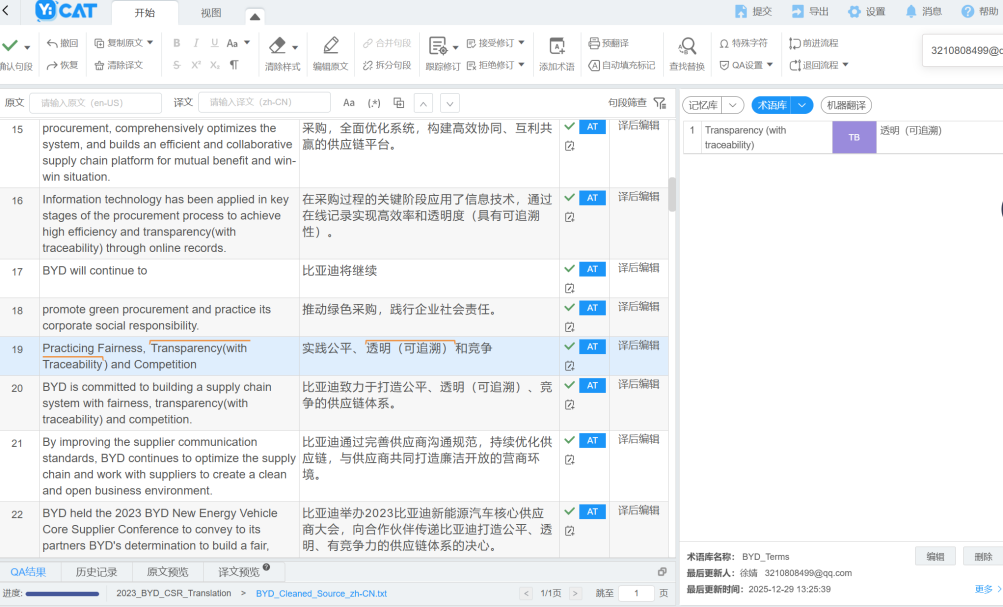
Human–machine collaborative translation (User-in-the-loop): In YiCAT, NiuTrans (小牛翻译) was called for pre-translation, and the CAT tool’s QA function and term enforcement mechanism (Term Enforcement) were used to correct machine hallucinations.
Quantitative quality evaluation (Evaluation): Taking the Chinese report officially published by BYD as the “gold standard (Reference),” the Hugging Face Evaluate library was used to calculate BLEU scores, quantifying the difference in quality before and after technical intervention.
III. Process and Analysis of Results
1. File Acquisition and Regex-Driven Corpus Cleaning (Data Cleaning)
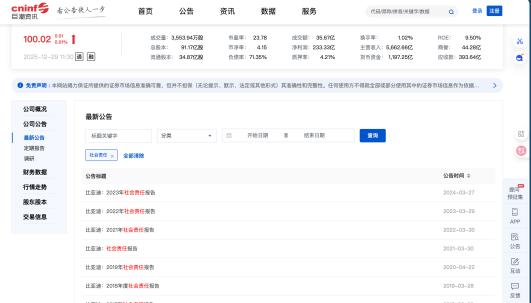
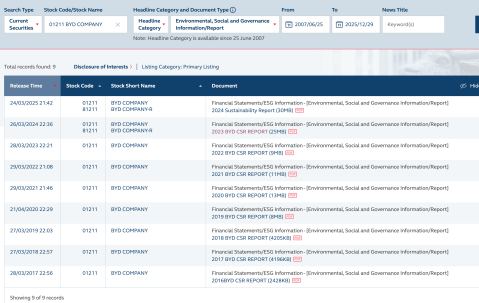
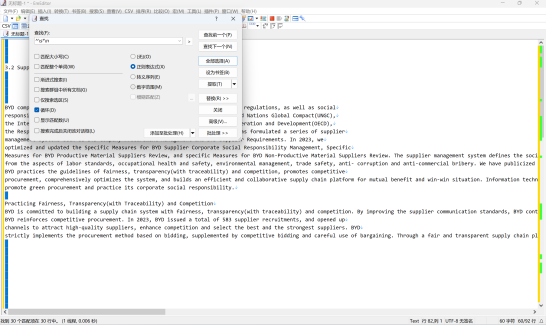
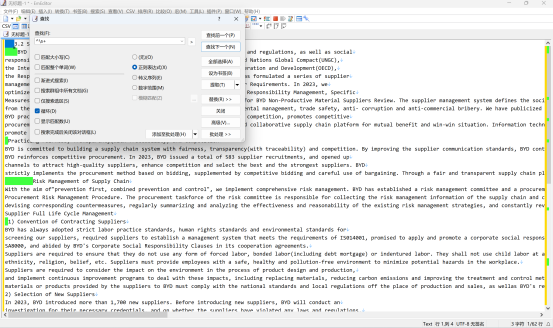
The file was obtained from HKEXnews (HKEXnews). Because the source file was converted from PDF, it contained serious formatting noise. Problem diagnosis: The original text contained many “false line breaks” and “word run-ons” (such as requirements.BYD), which caused the NMT engine to segment sentences incorrectly. Technical intervention: Regular expressions were written to repair the text and reassemble paragraphs. Result: The cleaned text achieved a 0% line-break error rate, effectively improving the coherence of the subsequent machine translation (Figures 1–6).
2. LLM Semantic Term Extraction and Term Base Construction
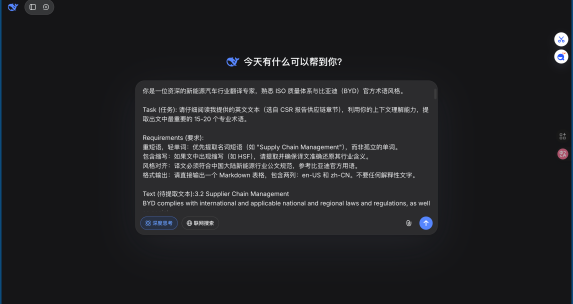
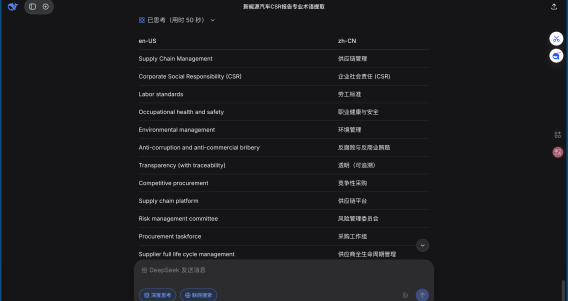
To address the pain point that traditional tools cannot recognize abbreviations, the report adopted an LLM-assisted extraction strategy. Procedure: A structured prompt containing “role setting + task constraints + style alignment” was designed, instructing the model to extract the top 20 core terms.
Analysis of results: The model successfully identified and aligned HSF (Hazardous Substance Free) with “有害物质减免” and Procurement Taskforce with “采购工作组.” Compared with traditional word-frequency statistics, the LLM accurately filtered out high-frequency general words (such as Vehicle) and produced an Excel glossary with a high signal-to-noise ratio (see Figures 7–8).
3. Term Enforcement and Dynamic Maintenance in the YiCAT Platform
After the term base was mounted on the YiCAT platform and NiuTrans pre-translation was enabled, the technical advantages became clearly visible. Term enforcement: when translating the “risk management” paragraph, the system automatically identified and highlighted Risk Management Committee and forced the NMT engine to render it as the officially standardised “风险管理委员会”, avoiding non-standard renderings such as “风控委” (see Figures 9–11).
4. BLEU Quantitative Evaluation
To assess translation quality objectively, the report compared the translation exported from YiCAT (Candidate) with the cleaned official Chinese text (Reference).
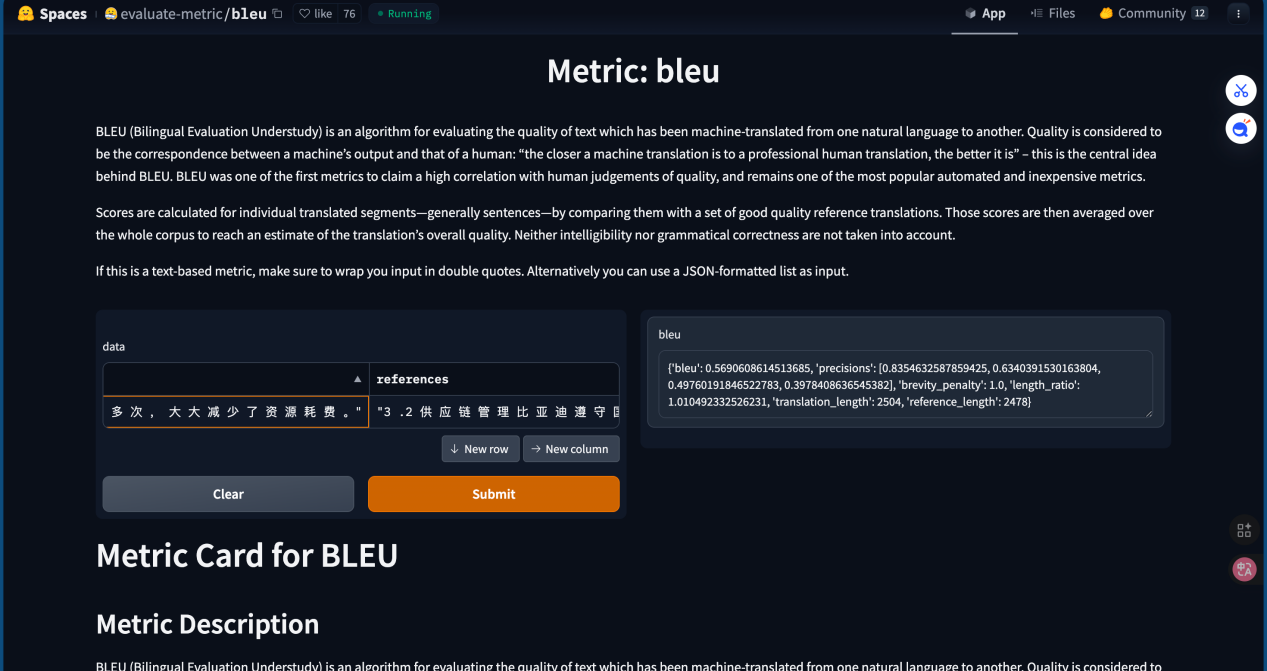
EmEditor regular expressions were used to segment the bilingual texts at the character level (Character-level Tokenization). Final score: the evaluation gave a BLEU value of 0.569 (that is, 56.9 points; see Figure 12).
Interpretation of the data: the raw output of NMT without terminological intervention generally has a BLEU value between 0.3 and 0.4. The high score of 0.569 strongly demonstrates the decisive contribution of “terminological consistency” and “format standardisation” to translation quality.
IV. Reflections and Conclusions
This practice has verified the great potential of a “combination of technologies” in professional translation, and has prompted the following reflections on a new paradigm of human–machine collaboration:
From “bilingual conversion” to “corpus governance”: the experimental data show that the improvement in the BLEU value depended to a large extent on the preliminary regex-based cleaning and on the character-level processing of the reference translation. This indicates that the core competitiveness of future translators will partly shift to their ability to handle unstructured data. The advanced direction of human–machine collaboration: in this practice, the closed-loop process of LLM term extraction and dynamic maintenance in YiCAT reveals a trend in human–machine collaboration from “task allocation” to “complementary capabilities”. Future translators will need to master basic programming skills in order to intervene in corpora more precisely, while machine translation systems will need to strengthen context awareness in order to reduce the cost of manual proofreading. This two-way integration of capabilities may redefine the productivity boundaries of professional translation.
The complementary ecology of LLMs and CAT: LLMs excel at “knowledge graph construction” (term extraction), while CAT excels at “process control and memory reuse” (consistency checking). Combining the two makes it possible to build an efficient workflow of “LLM first draft → CAT terminology unification → human polishing”.
Awareness of technical boundaries: although the BLEU value reached 0.56+, the machine still sounded stilted when handling culture-loaded words (such as “绿色征途”). This reminds us that technology aims at “noise reduction” and “efficiency improvement”, while the final “aesthetic gatekeeping” and “value transmission” of a translation remain the irreplaceable responsibility of human translators.
Rethinking human–machine collaboration: current practice shows that although the deep coupling of LLMs and CAT tools can markedly improve terminological consistency, machines still run the risk of semantic rupture when handling metaphorical expressions (such as “润物细无声”). This requires translators not only to possess corpus engineering skills but also to strengthen their ability to decode meaning in cross-cultural contexts, establishing a dynamic balance between technological empowerment and humanistic judgement. Future translation education needs to build a dual-track training system of “technical toolbox + cultural interpretive capacity”, so that translators can both command algorithmic logic and safeguard the warmth of language.