Reading Hideo Kojima’s “chirality” and “stranding” through Heidegger’s ontology of death
LLM translatedThis English version was produced by a large language model and may contain errors. Read the Chinese original
Introduction
Death Stranding is an open-world walking simulation created by the renowned game designer Kojima Hideo. It sets out to explore game mechanics well ahead of its time, aiming to “break the framework of game genres and create a game experience that subverts tradition.” The work carries a strong imprint of Kojima’s personal style. It draws mainly on cinematic shooting and narrative techniques and blends concepts from literary and philosophical theory to build its style and settings. After the release of Death Stranding, game media worldwide were sharply divided in their assessments. Less favorable reviews mostly found its narrative “sluggish, lengthy, and dull,” while more favorable ones included IGN Japan, which held that “the anthropological themes expressed through its references and homages have an incomparably profound appeal,” and GamerSky, which praised its “philosophical ideas full of wisdom.” Death Stranding is a work in which Kojima, past the age of forty, pursued “authorship” in artistic creation without regard for financial cost, and a medium through which he sought to express the primal roots of Homo Ludens (“the playing human”) and Homo Faber (“the making human”). Among its elements, the obscure settings that recur throughout the game, such as “Timefall,” “Chiral,” “Beached Things,” “the Beach,” and “Bridge Babies,” carry Kojima’s philosophical reflections on life and death.
The philosophical settings of Death Stranding fall broadly into three categories: chirality, stranding, and connection. Images such as ropes, sticks, hands, and Chiral belong to “chirality”; the Beach, Beached Things, Timefall, voidouts, and the reverse rainbow belong to “stranding”; and the network, Bridge Babies, umbilical cords, and the Heartman belong to “connection.” In the worldview of Death Stranding, life and death are not wholly opposed but are relayed and converted through “the Beach.” The dead, who still possess souls, struggle toward life on the Beach, and their bodies must be completely cremated before the connection to the world can be severed and they can be repatriated to the realm of the dead; otherwise, they will cause intense interference with the world of the living. Because the dead exist in an antimatter state, contact with the living results in matter–antimatter annihilation, causing severe destruction to the living world. On this basis, Kojima constructs an ontological inquiry into death built on “life–connection–death.” Read through Heidegger’s ontological understanding of death, it corroborates the claim that “death is being-toward-death, while the end is being-toward-the-end.” Beyond this, it also attempts to extend Heidegger’s theory of death: between death and life lies a connection that must be severed, because not only is life “being-toward-death,” but death is also “dying-toward-life”; not only must life face death, but death must also face its end.
This article will first briefly introduce the conceptual settings and worldview of Death Stranding, then interpret “chirality” from the perspective of the unity of opposites, and finally use Heidegger’s ontology of death to argue for “stranding,” “connection,” and “the end,” in the hope of offering a modest contribution that may prompt further research on Kojima’s philosophy.
1. Conceptual Settings and Worldview of Death Stranding
Death Stranding is set in the near-future United States. In a hospital, doctors perform a cesarean section on a brain-dead mother who is seven months pregnant. At the instant the umbilical cord is cut, a doctor comes into contact with an unknown creature from another spacetime, which immediately triggers a voidout, an explosive process in which mass is rapidly converted into energy; this process is called a Death Stranding. A series of voidouts then occur around the world, damaging global communications infrastructure and causing the collapse of the existing world order. Investigation reveals that the creature the doctor encountered was a Beached Thing (BT), the soul of a dead person that should have remained in the realm of the dead but has returned to the world of the living; contact with humans causes matter–antimatter annihilation and triggers a voidout. The residue left after a voidout is called Chiral matter, which is black and tar-like. When Chiral matter enters the atmosphere, it causes Timefall, and any living thing exposed to Timefall ages rapidly, a process known as chronological theft. Under the threat of Beached Things and Timefall, surviving civilians take shelter in underground bunkers, while a small number of porters form a surface transport chain to deliver goods.
After the Death Stranding event, research by the U.S. government found that a link exists between the world of the living and the realm of the dead, and this linking space is called the Beach. The Beach is a third space belonging to every living being that possesses a soul; it exists outside of time and space, and its form varies with each individual’s experience. Because the fetus in the womb of a brain-dead mother exists in a state between life and death, it is able to sense Beached Things; such infants are called Bridge Babies (BBs). The U.S. government conducted experiments on Bridge Babies in order to perceive the realm of the dead, attempting to connect the world of the living with the Beach. Chiral matter was collected and put to use. Because large quantities of Chiral matter are scattered across the surface, building a Chiral network makes it possible to connect to the Beach and to achieve instantaneous holographic projection, 3D printing, and data recovery.
The protagonist of Death Stranding, Sam, is a “repatriate” with the ability to come back to life after death. Over the several hundred million years since the Earth’s formation, there have been five mass extinctions: the Ordovician, Devonian, Permian, Triassic and end-Cretaceous extinctions. The prehistoric humans who were wiped out 5,300 years ago had black umbilical cords that did not decay, known as “Cord of the Dead” (冥带). The umbilical cords of mammals are a mimicry of this cord. Sam was removed from the womb of his brain-dead mother before a natural birth, and his umbilical cord was severed by the instigator of the Sixth Extinction. This also severed Sam’s connection to the Beach of the Dead (冥滩): after death he is rejected by the Beach and can only return to the world of the living by means of the Cord of the Dead. For this reason, the U.S. government exploits the fact that Sam is forever stranded and cannot die, inducing him to become a courier in an apocalyptic world so as to strengthen the chiral network further. At the same time, it uses bridge babies (BBs) as a medium for sensing stranded entities (BTs), and uses umbilical-cord scissors made from chiral crystals to cut the umbilical cords of BTs, with the aim of eliminating them.
2. The Unity of Opposites in Mutual Chirality
The “palm” is the most frequently recurring image in Death Stranding: BTs cannot be seen with the naked eye, but in the areas they pass through all vegetation withers and black handprints are left on the surfaces of objects; Sam’s body is covered with handprint marks, with one more handprint left each time he dies; once chiral matter has formed crystals, metal palms grow from the ground and reach toward the sky; after a BB detects a BT, the pod’s detector opens into the shape of five fingers and sways rhythmically; Sam suffers from aphenphosmphobia (fear of physical contact) and is afraid of touching human hands, and so on. The English name of chiral matter, “Chiral”, derives from the Greek word for “hand”, and “chirality” means “handedness”. Kojima Hideo explains it as follows: “The left hand and the right hand are mirror images of each other, but they are not identical in shape and so cannot be perfectly superimposed; this property is chirality. Chiral matter is therefore matter that possesses chirality.”
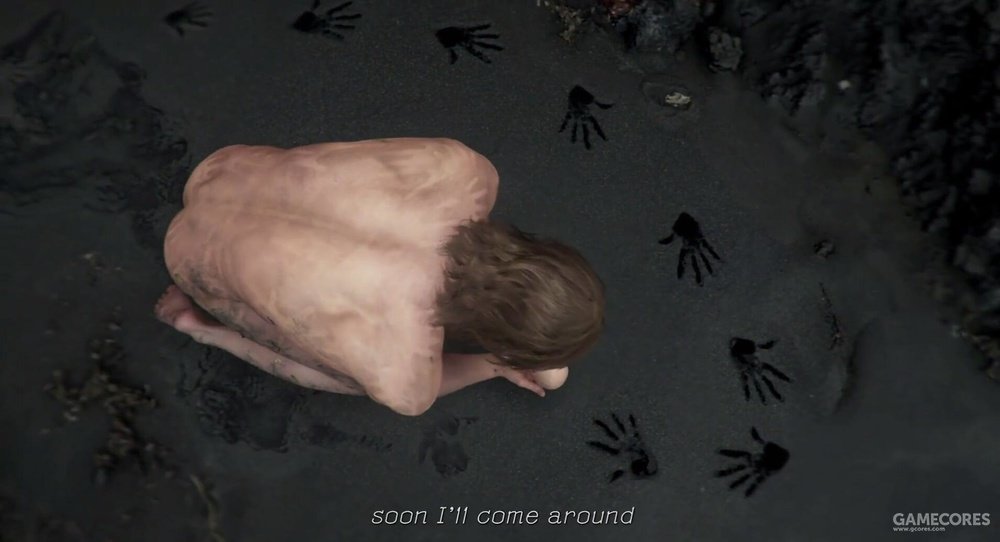
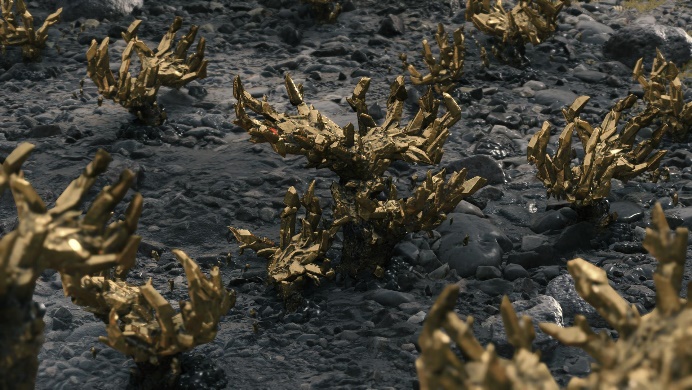
“Chirality” is a chemical property widely found in medical and pharmaceutical research. A chiral molecule cannot be perfectly superimposed on its stereoscopic mirror image; a molecule’s chirality is usually caused by an asymmetric carbon, and such molecules are called enantiomers. In living organisms, chiral isomers may exhibit completely opposite pharmacological, pharmacokinetic, metabolic and toxicological activities. For example, the thalidomide (“Reaction Stop”) medical disaster of the mid-twentieth century caused the deaths of newborn babies, or severe malformations of their hands and feet, in Europe and South America. The cause lay in the chiral compound in the synthetic drug thalidomide, whose spatial structures are mirror-symmetrical. The right-handed form of thalidomide (R-configuration) suppresses morning sickness and has a sedative effect, whereas the left-handed form (S-configuration) is teratogenic. Likewise, the R-configuration of the anaesthetic ketamine has a hallucinogenic effect, the R-configuration of penicillamine causes mutation, and the R-configuration of barbiturate sedatives can stimulate the central nervous system, among many other examples.
The chirality of Death Stranding is embodied in the opposition between life and death. In the universe, matter and antimatter are mirror images of each other and cannot be superimposed. Of these, the living people and babies of matter symbolise life and flow, while the BTs and stranded babies of antimatter symbolise death and stagnation. When rainbows hang inverted, chiral particles drift up into the sky and timefall rain corrodes the skin, this signals the arrival of death and aging. Matter and antimatter should occupy parallel spaces, but each intersection of the two will cause a void out. The deepening fusion of matter and antimatter represents termination and annihilation, ultimately triggering a mass extinction and leading the world toward the void. On this basis, the “end” in Kojima Hideo’s philosophy is far closer to nothingness than “death” is. The manifestation of “chirality” in quantum mechanics likewise echoes the inevitability of a future in which life moves toward death. “Life feeds on negative entropy; that is, life sustains and develops itself by drawing negative entropy from its external environment” is Schrödinger’s exploration of the cycle of life’s development. Entropy is a measure of disorder: the greater the entropy, the higher the degree of disorder, and the second law of thermodynamics also confirms the irreversibility of the universe’s increase in entropy. The entropy of the universe increases with the passage of time, and when it reaches its peak, all other usable energy will be converted entirely into heat; once matter reaches thermal equilibrium in temperature, the existence of meaning will be extinguished into termination. Seen in this light, Kojima Hideo is deeply pessimistic about the future of human society: although the maintenance of life is delicate, and death as a form of existence is likewise an orderly energy body, death’s nature still tends toward life (BTs constantly want to drag the living into the mire), so that if the orderly dead touch delicate life, a void out occurs, and life and death are annihilated together and return to chaotic void. So long as life and death are mutually chiral, mass extinction cannot be avoided, and the movement of all things toward their end is directional and irreversible.
3. Stranding, Connection and Termination
The “palm” in Death Stranding expresses “handedness” and also serves as a symbol of human connection or rejection. Kojima Hideo was deeply influenced early on by the existentialist writer Abe Kōbō, and the game’s prologue quotes Abe’s work The Rope: “The rope and the stick are the two oldest tools of humankind. The stick can keep evil things away, and the rope can draw good things near; both are the earliest friends humankind conceived. Where there are ropes and sticks, there are people.” In the game, the rope appears first, in the imagery of ladders, climbing ropes, roads and porters; the stick appears slightly later, in the imagery of fists, grenades and firearms. In building the game’s worldview, Kojima uses the “hand” to interpret the rope and the stick: “When people open their palms, they can build connections with one another by clasping each other’s hands; when they close their palms, the hands naturally become fists or sticks that shut others out. The two stand in opposition and unity, and cannot be separated.”
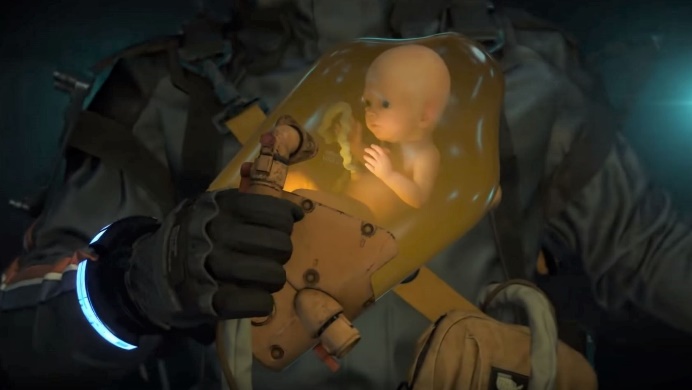
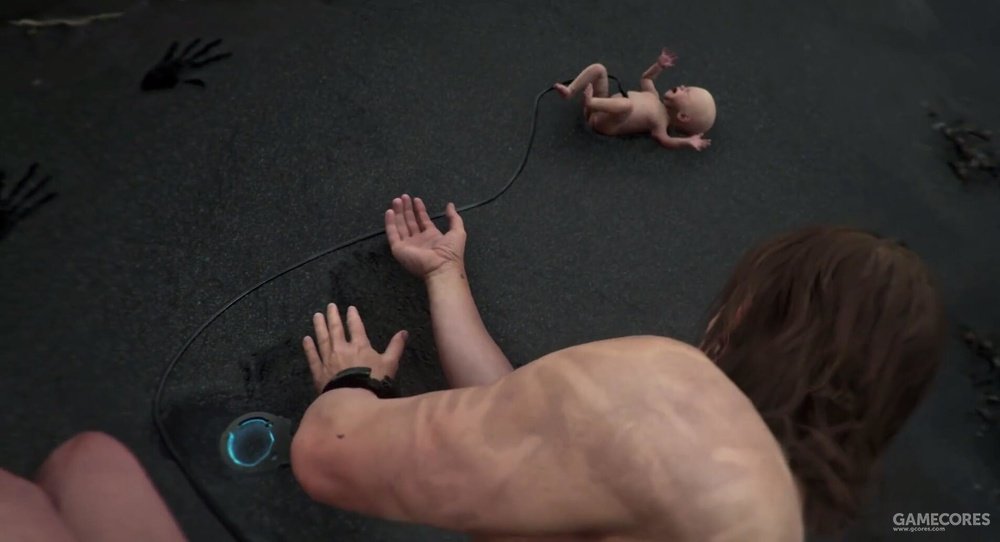
At the level of allegory, “connection” is reinforced through the image of Sam and the Bridge Baby (BB) he carries. When Sam revives on the Beach after a voidout, he finds the BB beside him in its damaged pod. Sam then connects with the BB, and the connector serves as the “umbilical cord” between them, allowing Sam to perceive Beached Things (BTs) clearly. Each time Sam is sent to the Beach and then repatriated through the BB, the BB acts as the link between Sam and the world of the living. When Sam uses the cord cutter to sever a BT’s umbilical cord and repatriate it to the realm of the dead, the cord acts as the connection between the world of the living and the realm of the dead. Finally, the BB is surrounded by the BT’s handprints, and the breaking of its cord leads to its death, leaving only the BB’s own handprint. This also echoes the oppositional nature of handedness: the handprints of the BTs of the realm of the dead symbolise death, whereas the BB’s handprint symbolises life. In the end, the strands (strand) of life and death are severed, leaving Sam stranded (strand) on the Beach.
In Being and Time, Heidegger holds that “death is not an event”; that is, death is not “demise” in the biological sense but “Being-towards-the-end,” in which “Dasein’s Being is a Being towards this entity’s end.” Death is thus a “Being towards the end.” During their time in the world, human beings are “living beings”; after death they become “the deceased,” so death is also a mode of being. Because death is itself inevitable and predetermined, human beings are endowed with the attribute of “existence” from the moment of birth, and after a complete or incomplete life they arrive at the ritual that ends life, “demise,” which is “running ahead into death.” Death is also insuperable: whether one lives long or dies young, one inevitably meets the end, so death is “Being towards the end,” and existence is “living towards death.” Death Stranding, however, creates a third and a fourth state beyond the dual states of “existence” and “death”: “annihilation,” which is complete termination, and the “Beach,” which is neither living nor dead. The union of life and death produces annihilation, while the umbilical cord, as a connection, ties together the life of the living (the BB connects with Sam in the world of the living), the life of those on the Beach (Sam returns to the world of the living through the Beach), the death of those on the Beach (the cord leading from Sam’s Beach to death is severed), and the life of the dead (the cords of BTs lingering in the world of the living). Death in the traditional sense is irreversible, and the dead cannot be revived; the death of Death Stranding is not only reversible but even interruptible. This extends the idea of death as “Being towards the end”: death is not only an inevitability of the world of the living, which will in the end pass from ordered entropy decrease to disordered entropy increase, but the world of the living and the realm of the dead run in parallel, and death, as the handedness of life, is also a form of being. Only when existence confronts death, and the positive and the negative annihilate each other to form the void of termination, is termination not merely the death of existence but death in the truest sense of death.
Individual living beings feel “anxiety” when facing their own death: “anxiety discloses death.” The living pursue eternity and immortality, and even seek to remain uncorrupted after death; in doing so they flee from irresistible death, yet also acknowledge death itself through anxiety. “That in the face of which one has anxiety is Being-in-the-world as such.” Hence, caught in the contradiction of both acknowledging and fleeing death, the living develop the formless, imageless “soul” as a vehicle for escaping death. They set body and soul in binary opposition, regarding the body as a “stinking skin-bag” or a “tool of reproduction” and holding that it possesses only animal nature, while regarding the soul as “everlasting” and “imperishable” and holding that its essence is truth, goodness and beauty. After “demise,” they shift the “cessation” and “vanishing” of death onto the body and preserve the intellectual integrity of the soul. They may even regard death as “the soul’s liberation from the shackles of the flesh,” or even pin their hopes on the guidance of unseen divine spirits toward reincarnation, with the possibility of fitting the soul with a better body. This not only runs counter to the forthrightness of Heidegger’s “running ahead into death,” but also cannot find room within the cosmic inevitability of “annihilation and termination” in Kojima’s vision.
4. Conclusion
The living fear death, but the dead not only do not fear it; they even long for a complete death, actively triggering the annihilation of matter and antimatter in order to “go to death” and hasten the arrival of true death. Viewed through the chirality of life and death, Death Stranding should logically go on to encourage the living to embrace death courageously and let the Earth enter an antimatter nuclear annihilation as soon as possible, thereby promoting the emergence and development of new species. But the game ultimately takes a different course: at the cost of keeping itself stranded on the Beach, the Extinction Entity suspends the Sixth Mass Extinction, and humanity is able to catch its breath and survive. This confirms Heidegger’s idea that “death is the shelter of Being.” Seen in this light, what Death Stranding truly expresses remains the mutual chirality of survival and death, which lets matter continue to decrease in entropy and antimatter to increase in entropy gently. This seemingly contradictory and antithetical mode of expression is also borne out by Kojima Hideo’s answer in an interview with INSIDE-GAMES: “As long as there are people who look forward to my work, I cannot die. Even if it means sacrificing myself, I want to keep making games.”
All images in this article are screenshots from Death Stranding (Kojima Productions, 2019).
References
- 505 Games: Death Stranding on Steam https://store.steampowered.com/app/1190460/DEATH_STRANDING/?l=tchinese
- Ariens E J. Stereochemistry, a basis for sophisticated nonsense in pharmacokinetics and clinical pharmacology[J]. European journal of clinical pharmacology, 1984, 26(6): 663-668.
- BBY. Death Stranding: Kojima Hideo’s “Philosophy of Death” https://www.douban.com/review/12193819/
- EGM Death Stranding Review https://egmnow.com/death-stranding-review/
- Game Informer’s Interview with Kojima Hideo: On the Purpose, Concepts and Philosophy of Death Stranding https://gouhuo.qq.com/content/detail/0_20190917163640_6mbMHIk7V
- Kagen M. The Worries of a Patriarchy: Death Stranding, Hideo Kojima (2019) [J]. Journal of Gaming & Virtual Worlds, 2020, 12(1).
- Wikipedia: Death Stranding https://en.wikipedia.org/wiki/Death_Stranding
- Xiaosilang: The Art of Naming in Death Stranding https://www.douban.com/review/12193819/
- Tu Xingyong. Heidegger’s Speculative Monologue on Death: The Sublimation from Death to Death Consciousness[J]. Journal of China University of Mining & Technology (Social Sciences), 2007, 4.
- Tu Toyong. Being, Dasein, Man: Three Dimensions of Heidegger’s Phenomenology of “Death”[J]. Journal of Tongji University (Social Science Edition), 2010, 1.
- Shaoya. A Full Plot Analysis of Death Stranding: Whose BB Is the BB in Sam’s Arms, Really? https://club.gamersky.com/activity/390526?club=163
- Zhang Weiguang, Zhang Shilin, Guo Dong, et al. Attention to Chiral Drugs: Starting from the “Thalidomide Incident”[J]. University Chemistry, 2019, 34(9): 1-12.
- Mi Susu. A Philosophical Reading of Death Stranding https://www.gcores.com/videos/118191
- Hu Xinhe. A Review of Schrödinger’s Philosophy of Science[J]. Journal of Dialectics of Nature, 1987, 2.
- Guo Qingtang, Zhang Jiyuan. An Analysis of Heidegger’s View of Death[J]. Journal of Liaocheng University (Social Sciences Edition), 2005, 1: 103.
- Martin Heidegger. Being and Time[M]. Beijing: SDX Joint Publishing Company. 2006.